
Mind · October 5, 2026 · Aurelio Forero
A Monday Morning with Satori
Your company already has a dashboard. Almost nobody opens it: when someone needs a number, they call the person who knows. This is the morning of a business owner and her team when that question no longer interrupts anyone, and the dashboard fills itself.
About this case. The information you are about to read is simulated, to preserve confidentiality. It is based on a real interaction with a Satori adopter. Valentina Fiore and Café Fiore are a fictional demonstration business. Only the section “Five weeks later” is different: it is a real case, told by the person who runs the company, without her name or the company’s.
The dashboard exists. Nobody looks at it.
Many companies have a Power BI set up. It took months, it has every indicator, and someone presented it proudly to a committee. And when the general manager needs to know how much is still owed to the company, he does what he has always done: he calls the person in collections.
This has been measured. In 2022 BARC and Eckerson Group surveyed 214 data leaders at companies around the world: on average, only 25% of employees actually use the business intelligence tools their company has already paid for. Three out of four have the dashboard one click away and don’t use it.
What they do, in the companies I know, is ask. They’re right. A question takes ten seconds, in your own words, and the answer comes with context: the number, why it changed and what’s coming. A portal asks you to remember the password, find the filter and know how to read the chart.
Asking has a single flaw: every question interrupts someone.
That flaw is what Satori removes. Satori is a Mind: a personal artificial intelligence that lives on your computer, carries your company’s context, remembers for you and gets things done. You ask it the way you would ask your best colleague. The difference is that you take up no one’s time, and that while it answers it keeps everyone’s dashboard up to date.
It’s easier to see on one specific morning.
8:40 a.m.: she says hello
Valentina Fiore runs Café Fiore: specialty coffee roasted in Bogotá, with a team of nine. She didn’t work over the weekend. She opens her computer and types one line.
Valentina
Hi Satori, good morning.
Satori
Good morning, Valentina. Your summary for today is already written. Today’s calendar: free until 3:00 p.m.
- Your three for today: the coworking proposal (due Wednesday) · the payment the bank rejected from the online store · the tax filing that was due on Friday.
- Tomorrow, 2:00 p.m.: meeting with the farm in Huila, no agenda. Before that you need to decide how much coffee you’ll buy from them.
- System: last night’s backup flagged an error. I’m looking into it.
- Your sister wrote at 8:32: she asks to take the line about delivery times and the one about returns off the website.
Should I remove the returns line too? I would remove only the delivery-times one: the returns line protects Café Fiore with the customer.
Nobody prepared that summary for her. Satori read the email, the calendar and what was left pending on Friday, and sorted it by what is due first.
8:47 a.m. · she unloads everything she has in her head
Valentina
As you saw, I didn’t work this weekend. I was at a school friend’s farm.
- I met an engineer who started a company that makes coffee machines for offices. Look him up online, without spending much. He told me we should sell the coffee with the machine included, as a subscription. It’s a project to plan.
- We need to put together the coworking proposal. You have everything. I want to send it this week and close.
- The new restaurant starts this week. Check the email from their manager and send the invitations to the three barista trainings today.
- Let’s make the change my sister asked for on the website. Also, this week we don’t ship until Wednesday: put up a notice and block Monday and Tuesday for online orders.
- Send my sister the documents she asked for by chat.
- I moved the tax filing to tomorrow. It’s urgent, but the work has to be spread out.
- Check the backup issue.
- About the rejected payment for the pastry shop’s ads: are those ads we made, or did she make them on her own? How much does she owe? Does it affect us? It’s delicate; I don’t want to write to her without a clear picture.
- Listen to the voice note the salesperson sent me on Friday about the hotel quote. I agree with him.
- Go through all the emails and group them by topic.
- With all of this, make me the plan for the week and ask me whatever you need.
Eleven requests, dictated in the order they came to her. She gets up for a coffee.
9:25 a.m. · thirty-eight minutes later
Satori
Done:
| What | Result |
|---|---|
| Café Fiore website | Published and checked live. Line removed, notice up (it comes down on its own on Thursday), Monday and Tuesday blocked. |
| Documents to your sister | Sent by email, with both attachments. I told her about the website changes while I was at it. |
| Backup | False alarm. The backup did arrive; the alert was badly calibrated and I’ve fixed it. |
| Pastry shop ads | We created all the ads. Total spend: COP 2,800,000. The debt is on her account, not yours. She paused a campaign today: she already knows. |
| Salesperson’s voice note | Transcribed. He asks to quote only the coffee now and leave the machines for later, so the total figure doesn’t scare the hotel. |
| The engineer | I found his company, his channel and his public track record. Two searches, nothing more. |
| Emails | 45 emails in 11 topics. Three need action from you; the rest is noise. |
Your plan for the week is written, day by day. The heavy piece (the coworking proposal) I’m starting today in a separate window so it doesn’t slow down the rest.
What I didn’t do, and why: I didn’t write to the owner of the pastry shop. It’s money and it’s your relationship: that one is your call.
Three questions to keep going:
1. The restaurant trainings: their manager wrote “Wednesday 8 to 10” without saying morning or evening. I would schedule them in the morning and confirm it in the invitation itself. OK?
2. The coworking proposal: list price, or a discount for a one-year commitment? I would go with list price.
3. The subscription with the machine: do I plan it this week or leave it for next week? I would leave it for next week.
What just happened
- She didn’t fill in a single form. She spoke the way she speaks to a person.
- Satori didn’t ask permission for what can be undone. It did it and reported it.
- It stopped at three things: money, legal matters and delicate messages to third parties.
- When it asked, it said which option it would choose.
- Nothing depended on her remembering anything: the plan, the emails and the decisions are all written down.
So far, one person’s morning. What comes next changes the day for the other eight.
10:15 a.m.: the team arrives and asks Valentina nothing
Julián, the head roaster, is going to roast the coffee for the coworking space. Before he starts he needs to know whether the client approved the change of origin. A year ago he would have messaged Valentina and waited, or roasted on an assumption. Today he asks his own Satori.
Julián
Has the coworking space approved the change of origin yet?
Julián’s Satori
Yes. They approved it on Thursday at the cupping meeting and it’s in the minutes, which are in the Cockpit, with one condition: not to go over the agreed price per kilo.
You have a task in your name that came out of that meeting: send the samples of the new roast on Wednesday. Valentina is sending the client the proposal this week, so your samples go with it.
Shall I open the minutes for you, or start the list of what changes in the roast?
Julián interrupted no one and didn’t roast blind. “I used to wait for Valentina to answer. Now I roast with the minutes open,” he says.
Valentina never even knew about the question. What each person discusses with their Satori is theirs. What reaches the dashboard is what the team already shared in its meetings: commitments, dates and results.
Mariana, from the store, also handles Café Fiore’s collections. On Fridays she used to write a report that took her the whole afternoon and that nobody read in full. She no longer writes it: what she did during the week was recorded as she did it, because she did it with her Satori. When Valentina wants to know how receivables are doing, she asks. Mariana hears about it the day there is something only she can solve.
The Cockpit: the whole company in one place, with nobody feeding it
All of that has a visible face. It’s called the Cockpit, and it’s the company’s dashboard: what comes in and what goes out, what is due, each person’s tasks, the meetings, the documents.
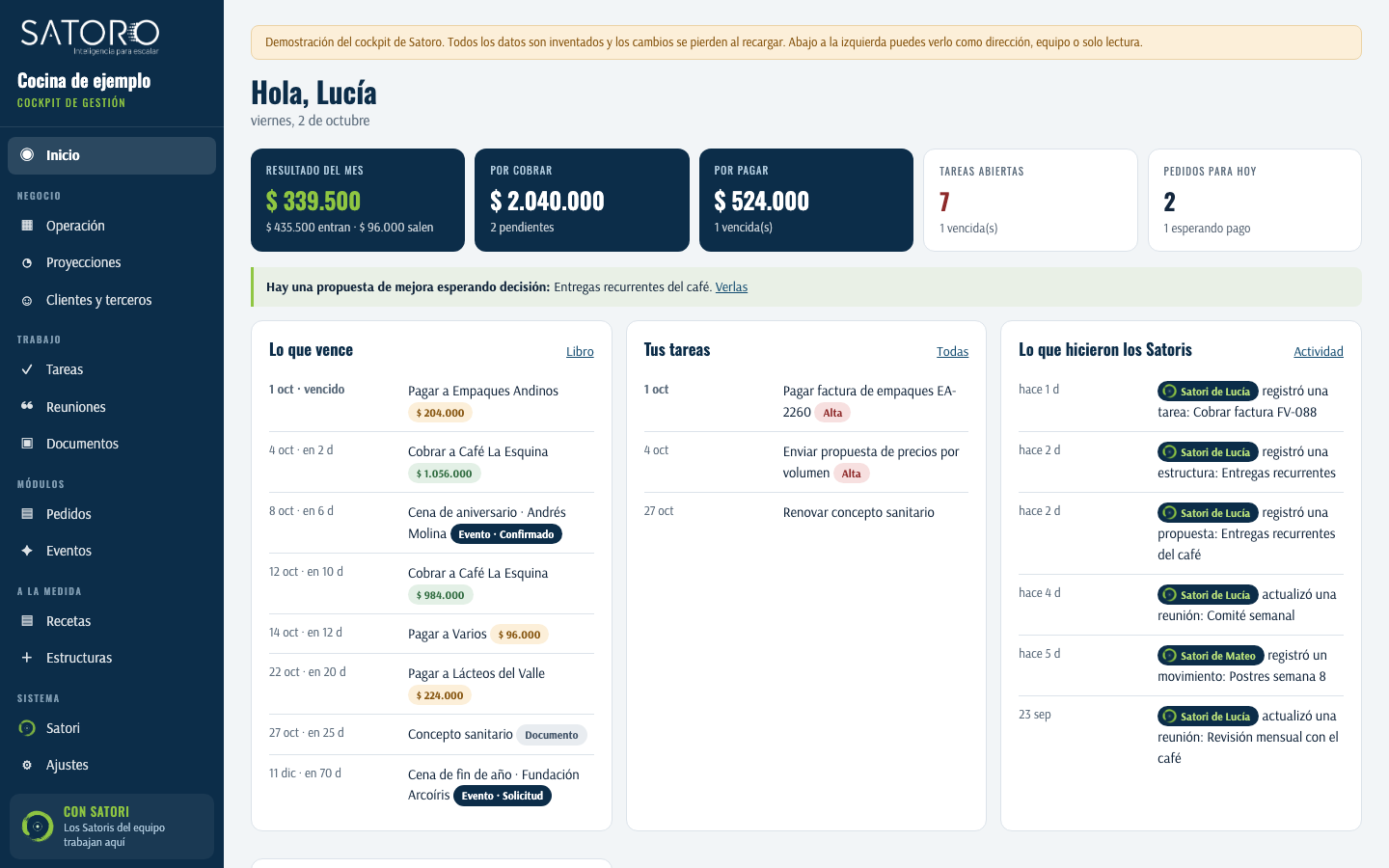
Up to here it’s a dashboard like any other. What’s different is in the right-hand column, “Lo que hicieron los Satoris” (what the Satoris did). That’s where you see how the dashboard was filled: the team’s assistants did it, while each person did their own work.
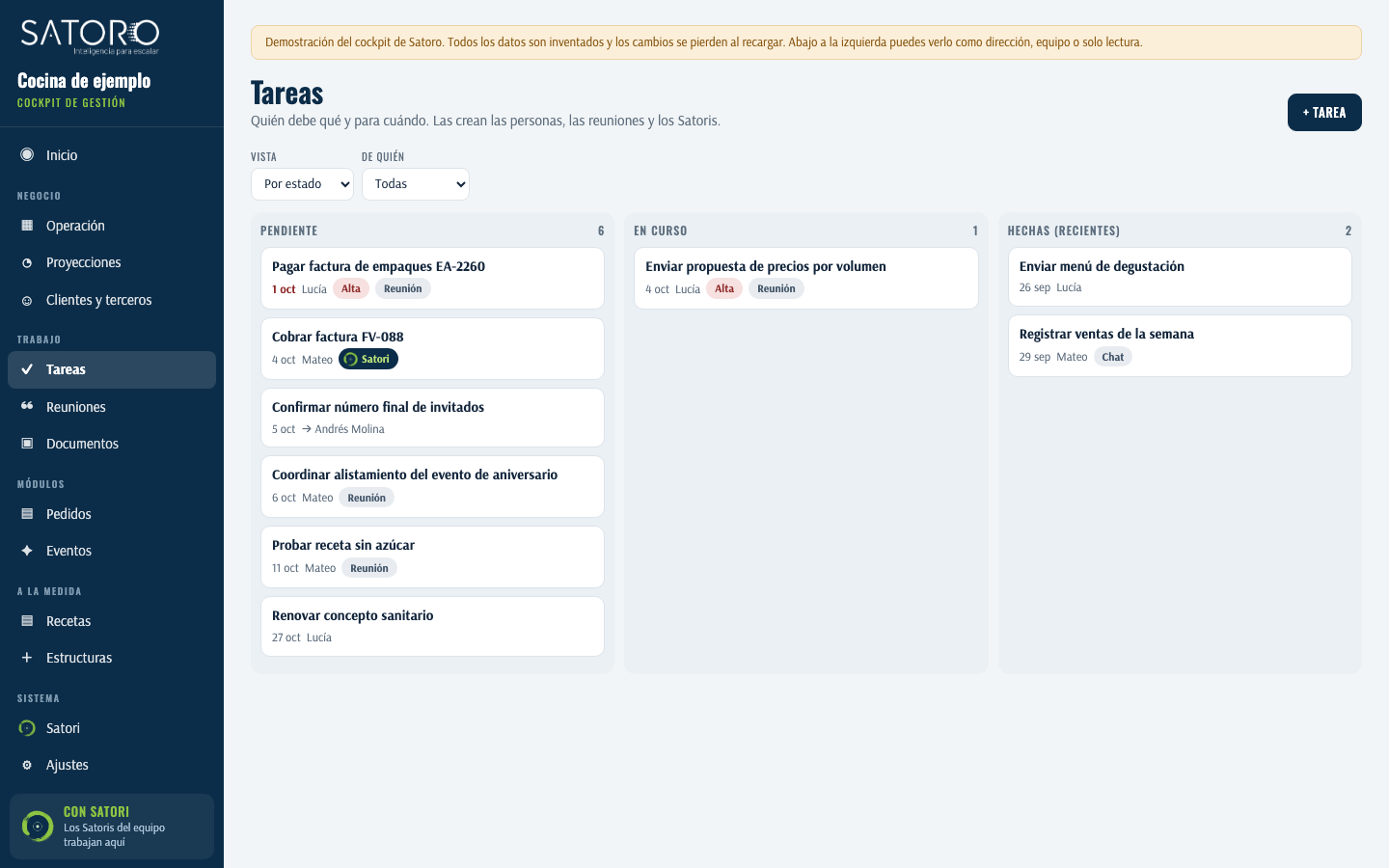
Look at the labels. Julián’s task was born in Thursday’s meeting. Nobody typed it in: Satori processed the meeting, pulled out the commitments and assigned each one to the person who took it on. That is the work that kills task-management software, and here no person does it.
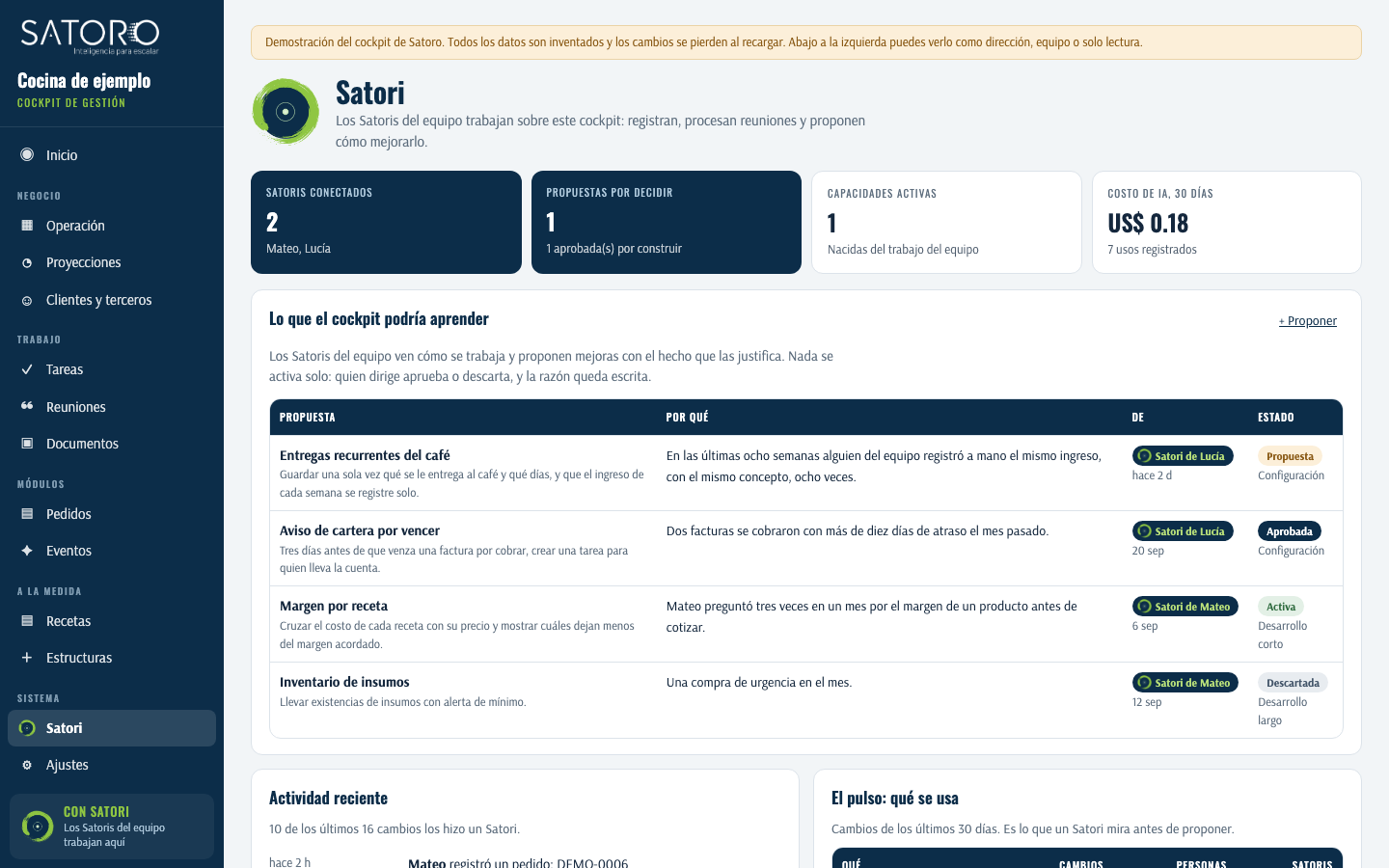
The day I took these screenshots, in the demo company ten of the last sixteen changes to the dashboard had been made by a Satori. And there is something finer: one of them noticed that someone on the team had entered the same income by hand eight weeks in a row, and proposed saving it once so that it records itself. Nothing turns itself on. Whoever runs the company approves or discards, and the reason is written down.
You can walk through it yourself: the demo is open at satoro-cockpit-demo.vercel.app.
The portal becomes one more tool. You open it when you want to see the whole picture. The day-to-day gets solved by talking.
And what you work on with your Satori is kept up to date for everyone else. Nobody in the company has the job of maintaining a piece of software.
Five everyday problems in a small team
I hear them every time a business owner tells me about their week. The business changes and the country changes. The problems repeat.
1. The deliverable buried in the chat
The document was sent. It arrived on WhatsApp among forty messages, got a hurried glance, and a week later someone asks about it. The channel failed, and the people share the annoyance. With Satori, what was delivered is recorded where people look for it. “Did they send me the contract yet?” has an answer with a date and the file.
2. The report that is a second job
Reporting comes when the work has already worn you out, and almost nobody does it well at that hour. Whoever runs the company doesn’t want to read ten pages either: they want a short list of what has to be solved today. Here the report comes out of the work itself, because what each person did with their Satori is already on record. And the short list is Valentina’s “three for today.”
3. The question “where are you on that?”
It tires the person who asks and the person who answers. When every task has an owner, a date and the meeting it came from, that question is unnecessary. The team gains afternoons without interruptions, and whoever runs the company gains the peace of mind of not having to chase anything.
4. The inquiry that arrives after hours
A customer writes on Friday at six in the evening. On Monday that inquiry is at the top of the morning summary, with a drafted reply. Someone on the team reviews it and sends it.
5. The task-management software nobody adopted
Many small teams have tried more than one. They fail for the same reason the dashboard fails: they have to be fed, and that is work that doesn’t pay off for the person doing it. Here the dashboard feeds on what people already do. The same goes for what only one person knows: every conversation with their Satori leaves a piece of it in writing, without asking them to sit down and document.
Five weeks later: what changed at a retail company
Valentina is a character. What follows happened. The CEO of a retail company with 34 points of sale in 17 cities installed her Satori at the end of August. In early October we asked her for two things: that her Satori tell us what it had done, and that she tell us what had changed.
The list of what was done is long: seventeen jobs finished and six in progress. There is a financial and commercial diagnosis done in the first two days, a Marketing board with 246 tasks migrated in one day, and even a family calendar to read on the phone.
The change is told by her, in five jobs. For each one she says how it was done before, what made it hard, what is different now and what changed for whoever receives it. The times are her estimates, not measurements.
1. The daily target for each store
Before, a target was set only for the highest-selling days, and the rest was tracked on the go. Splitting the month’s target day by day and store by store, with clear rules, was an analysis nobody managed to do at that level of detail. Today every store has its target for each day, tied to the month’s target, plus targets at hourly checkpoints. Conversations with the store managers “focus on business indicators and not only on perceptions.”
For me this is the most valuable one. The trajectory of the result gets corrected during the month. At month-end there is nothing left to correct.
2. The monthly report to the owner
She used to put it together herself. Pulling the data took her at least two days, and writing it, one more. Today she sends it in one day and in three pages at most. Before she delivers it, her Satori checks every figure against the source. For the owner, “it is much clearer where the wins are and where the business’s areas of opportunity lie.”
3. The sales analysis by store and by product
The supply team did it every week. The report went out, but it didn’t say clearly and in time where the opportunities were. Now Satori reads the complete sales records, not just the summary tables. There is a sheet for each store and a reading by product “that ends in what has to be decided.”
From this job I keep one sentence of hers. The analysis “also separates what came from external events, such as an earthquake, an election or a football World Cup, so that it isn’t charged to the team.” With the external set aside, the forecast becomes credible. And a credible target can actually be met.
4. The sales force ranking
The zone managers decided transfers between stores using the productivity ranking prepared by payroll. Performance against target was cross-checked with the transfers, but many times the decision “was based only on perceptions.” Today there is a ranking by store, by store manager, by sales consultant and by store team. Each store manager is placed according to their performance and whether they are rising, steady or falling, with an action for each group. Follow-up is monthly and looks at the trend.
5. The training material for the sales force
The company’s trainer made it. There were documents for 15 of the 42 product lines, and preparing the one for a single line took about five days. Today all 42 exist, made between September 8 and 28 and reviewed page by page, with a core manual, group sales exercises and an assessment questionnaire. In-person training has already started.
Do the math: at five days per document, 42 come to about 210 working days. They were done in three weeks. And the salespeople “are happy and at ease having all the information. That gives them confidence when it’s time to sell.”
What I read in those five jobs
Look at who used to do them. Three of the five belonged to other areas: supply, the zone managers and the trainer. Her Satori raised the level of the whole team’s work.
Look also at what made each one hard. The daily target, the analysis by product and the ranking required a level of detail nobody managed to produce. That is the productivity that weighs most: being able to do what couldn’t be done before.
Her Satori notes one more change. Her corrections are kept as standing rules: about 40 in five weeks. That is how a good colleague learns how the person in charge likes the work done. Here, on top of that, it was written down.
At the end we asked her one question: what can you do today that you couldn’t do five weeks ago? This was her answer:
“Based on Satori’s information and analysis, I now spend my time making more and better decisions. It has also allowed me to have the business conversations and discussions with the different teams that challenge their goals and move them out of the status quo.”
CEO, retail company with 34 points of sale in 17 cities
What Satori doesn’t do
It doesn’t decide for you on money, legal matters or delicate messages to third parties. There it stops, asks, and tells you which option it would choose.
It doesn’t watch anyone either. It records the work each person hands it. The team adopts it because it takes away the Friday report and the question at eleven at night.
The dashboard stopped being a task. Now it fills with the work you already do.
By 9:25 Valentina had her week planned and three decisions to make. Her team arrived and found the tasks in place, each with the meeting it came from. By noon Café Fiore’s dashboard was up to date and nobody had opened it to update it.
This is what a Monday looks like when the company has a memory.
—Aurelio
Source: BARC and Eckerson Group, “Strategies for Driving Adoption and Usage with BI and Analytics,” global survey of 214 data and analytics leaders, April 2022.
By the same author: Expensive People Doing Cheap Work · It All Depends on You. And It’s Not Enough.
More cases like this one: Instagram @satoro.ai · satoro.ai